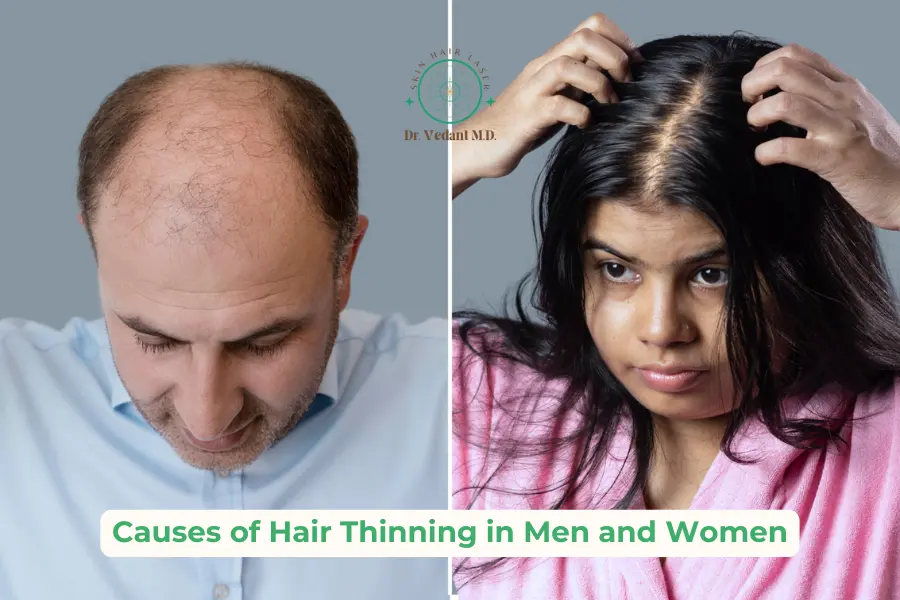
Thinning hair is a top concern for males and females. During shedding, a normal daily occurrence (50-100 strands), many people notice obvious thinning in specific areas, decreased volume, or exposed areas of scalp. Recognising the root cause will aid in effectively controlling and managing the situation.
Thinning hair is not an overnight phenomenon, but is rather the result of both internal changes and external influences (lifestyle choices) or could be a symptom of an underlying health problem. Dr Vedant Ghuse, the top hair specialist doctor near me shares the causes that both genders need to be aware of:
The leading cause of thinning hair in both sexes is genetics.
Men: This is referred to as male pattern baldness, beginning with a receding hairline and vertex thinning.
Women: This is known as female pattern hair loss, generally exhibiting overall thinning or a widening part.
Genetic hair thinning will advance gradually; therefore, it is essential that there is early intervention for the best possible results.
Hormones affect how hair grows.
For women:
These conditions cause diffuse thinning and excessive shedding.
For men:
Sensitivity to Dihydrotestosterone (DHT), the male hormone, results in the shrinkage of the hair follicle as the body ages.
Physical and emotional stress can lead to telogen effluvium, a condition where your body’s hair follicles have a large number of them enter the shedding phase earlier than the natural cycle would normally allow. Common triggers of telogen effluvium are:
Fortunately, telogen effluvium is generally temporary and reversible once the trigger is identified and resolved.
Your hair requires fuel to keep growing, and when you lack certain vitamins and nutrients, your hair becomes weak, which contributes to the thinning process.
Dr Vedant Ghuse, a trusted dermatologist doctor near me, shares some deficiencies linked to thinning hair, including:
Extreme dieting and imbalanced meals can also cause increased thinning in young adults.
A number of medical conditions can affect hair growth more than you may think they do.
If you experience a rapid onset of severe hair thinning, you must contact your physician so they may perform appropriate diagnostic tests.
In some cases, excessive heat styling. tight styles or updos (these can cause traction alopecia), and chemically treated hair can all contribute to the ultimate result of thin hair, which will appear as fine, weak strands that lack volume. Overuse of these products will create weakness within the hair shaft, allowing it to break easily, and will also result in hair appearing lifeless.
Age contributes to the thinning of an individual's hair. As we grow older, our follicles become smaller, our hair grows more slowly, and naturally becomes finer. The thinning becomes noticeable usually after the age of 40. This holds true for both men and women.
In conclusion, the cause for thinning can be varied. The most important factor in identifying the specific problem affecting the individual's hair is to get the proper diagnosis and treatment, so that a specific treatment program can be utilised. By treating individuals early on in their hair loss journey, adopting healthy habits and selecting the best care for their hair, they can greatly reduce the chances of experiencing a greater amount of hair loss than what is already anticipated. Hence, it is essential to search for an experienced dermatologist near me and consult the specialist for an early diagnosis.