
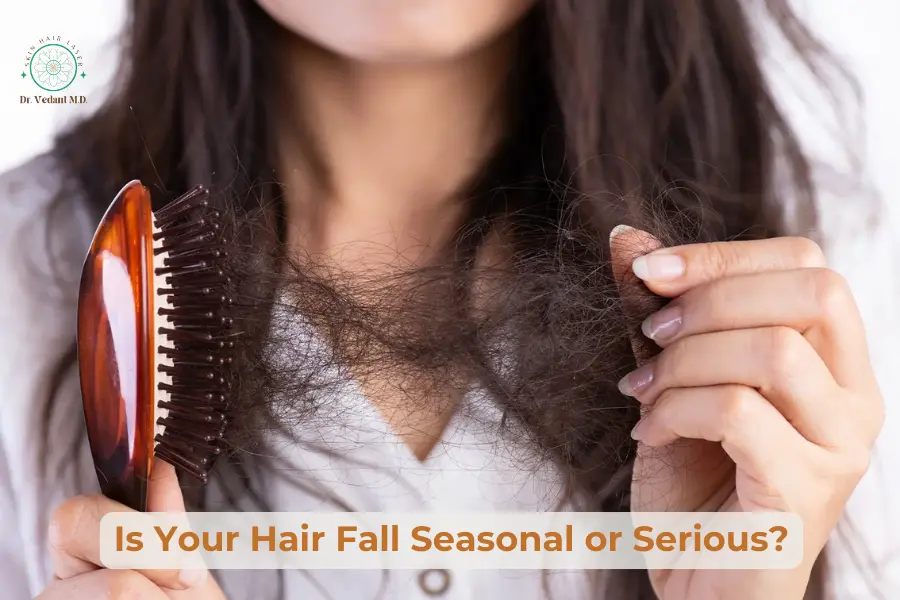
Finding an increase in your shed hair lying upon your pillow, collected in your drain, or on your hairbrush can be scary when it happens suddenly. However, before you become overwhelmed by dread, remember that not every occurrence of hair shedding warrants alarm bells. Dr Vedant Ghuse, a trusted hair specialist doctor near me, explains that in many cases, it might just be seasonal. The real issue is how to distinguish between a typical episode of hair shedding versus something more worrisome.
Your hair goes through a natural cycle of growth (anagen), rest (telogen), and shedding phases. Besides consistent shedding, several portions of your total hair can be shed at any given time. Early days of the fall season (when winter begins) and early spring are typically characterised by large amounts of seasonal shedding.
However, there are some times of the year (like late summer or early monsoon season) that can cause an increase in hair loss due to some other causes (such as increased humidity/temperature changes or the sun). These situations create an ideal environment for hair to fall more than usual, sometimes so much that you believe that your hair is falling out all at once. Fortunately, the increased levels of hairfall resulting from seasonal hairfall are often resolved naturally within weeks to a couple of months.
Persistent or severe hair loss can indicate a problem. Telogen effluvium is a common cause and occurs when a large number of hair follicles shed due to stress, illness, hormonal changes, or nutritional deficiency. As a consequence of this condition, the person may have noticeable thinning of hair on their scalp and thus experience growth outside the normal hair growth cycle.
Androgenetic alopecia is another concern. It is hereditary and causes loss of hair to occur gradually (and usually in a thinning pattern, based on location; i.e., around the hairline, at the crown, etc.). Unlike seasonal shedding, this form of hair loss is chronic and may require ongoing treatment to manage.
According to Dr Vedant Ghuse, the best skin and hair specialist near me, if you are experiencing seasonal shedding, it will most likely last for a short amount of time, have a fairly even distribution of hair across your whole head, and will not result in any visible areas of loss (bald patches or areas of significantly reduced density). Generally, once your hair growth cycle normalises and the shedding phase is over, your density will return to normal.
If you are experiencing chronic or hormonal hair loss, it is often associated with some type of other problem (dandruff, itchy scalp, texture changes, etc.), the hair is constantly growing out of its cycle, and will continue to get worse until it is treated accordingly.
On the other hand, serious hair fall is persistent, worsens over time, and may often be accompanied by other symptoms like dandruff, scalp irritation, changes in hair texture, etc that can make the hair loss worse.
Lifestyle factors play an important role in hair thinning/loss because poor diet, insufficient rest, frequent heat and/or chemical styling, and stress can all contribute to the thinning/loss of your hair. By addressing lifestyle factors like these, you should start to see improvements in your hair quality.
If you've experienced hair loss for more than 6-8 weeks, have noticed a significant amount of hair fall, or have developed a receding hairline, you need to seek out professional advice as soon as possible. Getting a proper diagnosis of your hair loss as soon as possible can help you prevent further hair loss and improve the outcome of your treatment program.
Although it is sometimes extremely confusing for people who experience hair loss, understanding the pattern and reasons for the hair loss can make it much easier for them to take the correct action to treat their hair loss. When in doubt, always search for an expert like Dr Vedant Ghuse, the top dermatologist near me, to achieve stronger and healthier hair.